Stop Wasting Cash on Generic Backlinks and Do This for Local Rank Instead
I see it every single week. A small business owner – maybe a plumber in Dallas, a roofer in Tampa, or a lawyer in Chicago – comes to me frustrated. They’ve been paying an agency $2,000 a month for “SEO,” and their report is filled with high-DR (Domain Rating) backlinks from tech blogs in Estonia, lifestyle sites in the UK, and “general news” sites that look like they were built in 2004. They ask me why, despite all these “high-authority” links, they are still stuck on page two of the Map Pack. The answer is simple: your google business profile seo strategy is stuck in 2015, and you are being sold a bill of goods that doesn’t move the needle in a proximity-based environment.
As a Google Business Profile Product Expert, I’m here to tell you that a link from a DR 80 tech blog does almost nothing for your local ranking if it lacks geographic relevance. Google’s local algorithm is a different beast entirely. It doesn’t care about “global authority” nearly as much as it cares about “local prominence” and “verified presence.” If you want to rank google business profile listings in 2026, you have to stop chasing the ghost of generic backlinks and start building a Local Mesh. In this deep dive, we are going to deconstruct the myth of the generic backlink and show you exactly what is actually driving the 3-Pack in the current AI-filtered search landscape.
Section 1: Why the Google Map Pack Algorithm is Different
Most SEO agencies treat the Map Pack like it’s just a “mini-version” of organic search. It isn’t. While organic search relies heavily on content and traditional link equity, the local algorithm is built on three specific pillars: Relevance, Distance, and Prominence. This isn’t my opinion; this is straight from Google’s official documentation. However, what Google doesn’t tell you is how the weight of these pillars has shifted over the last 24 months.
Distance used to be the “unbeatable” factor. If you weren’t physically close to the searcher, you didn’t rank. While distance still matters, Google has shifted toward “Prominence” to ensure they aren’t just showing the closest business, but the best and most trusted business. But here is the kicker: Prominence for local search is not the same as Prominence for a national e-commerce site. Local Prominence is defined by how well-known your business is within your specific service area. To master this, you should check out Master the Google 3 Pack: Proven Map Pack SEO Strategies for 2025.
Google is looking for “Neighborhood Mentions.” If you are a plumber in Dallas, Google wants to see your business mentioned on the Dallas Chamber of Commerce site, the local Little League sponsorship page, and in Dallas-based news outlets. A mention on a neighborhood blog in Oak Cliff is worth more to your local rank than a guest post on a national “Home Improvement” blog. Why? Because the neighborhood blog provides Geographic Relevance. When you focus on google business profile optimization, you are signaling to Google that you are a pillar of that specific community, not just a digital entity floating in the ether of the internet.
Section 2: The “Drain to Drain” Case Study, Authority vs. Activity
If you still believe that you need a high Domain Authority (DA) to rank, let’s look at the data. We recently analyzed a case study involving Drain to Drain, a plumbing company in Jupiter, Florida. When they started, they were a brand-new domain with a DA of 8. They were competing against legacy franchises and established local companies with DAs ranging from 35 to 50. Some of these competitors had 10 to 28 times more domain age and a staggering 384 times more backlinks.
According to traditional SEO logic, Drain to Drain should have been buried. Instead, they dominated the 3-Pack for high-intent keywords like “emergency drain cleaning Jupiter.” How? They ignored generic backlinks and focused on “Proof of Presence” signals. They used tools like DataPins to drop GPS-coordinated pins every time they completed a job. These pins created a “heat map” of activity that Google’s crawlers could see. This is the ultimate google maps ranking service secret: activity and proximity signals trump old-school link equity every single time.
The lesson here is clear: stop asking your agency for more links. Instead, read my guide on Stop Asking Your Local SEO Consultant for Backlinks and Do This Instead. When Google sees a constant stream of GPS-validated data and local interaction, it assigns a “Trust Score” to your profile that no amount of offshore guest posting can replicate. The “Drain to Drain” case proves that a small, active, locally-relevant site will beat a bloated, “authoritative,” but stagnant site in the local maps every day of the week.
Section 3: The 2026 “Interaction Score”, The New Ranking King
As we move into 2026, the local algorithm has evolved beyond static signals. We are now in the era of the Interaction Score. This is part of what industry insiders call the 2026 Trust Update. Google is no longer just looking at what you say about yourself or what other sites say about you; they are looking at how actual human beings interact with your Google Business Profile (GBP) in real-time.
What constitutes an Interaction Score? It’s a combination of “Click-to-Call” rates, “Request for Directions,” “Verified Open” status checks, and dwell time on your profile photos. If a user searches for your service, clicks your profile, stays there for 45 seconds looking at your recent project photos, and then clicks “Call,” your Interaction Score skyrockets. If they click your profile and immediately bounce back to the search results, your score drops. This is why you need to implement 5 Proven Map Pack SEO Fixes for the 2026 Trust Update [New] to ensure your profile is optimized for engagement, not just visibility.
Data from Uberall suggests that high numerical ratings (4.5 to 5.0 stars) and, more importantly, the velocity and depth of reviews are the top conversion and ranking factors for 2026. A review that says “Great job!” is fine. A review that says “John from ABC Plumbing fixed my burst pipe in the Highland Park neighborhood and arrived within 20 minutes,” accompanied by three high-resolution photos, is gold. These “Photo-Rich Reviews” provide Google with AI-readable context about your location and your service quality. Google’s AI-filtered Map Pack listings now prioritize businesses that show consistent, high-quality human interaction. If your profile is a “ghost town” with no new photos or reviews, you will lose your spot to an active competitor, regardless of your backlink profile.
Section 4: Stop Chasing DR, Start Building Local Mesh
If generic backlinks are the “junk food” of google maps seo, then “Local Mesh Signals” are the organic, nutrient-dense superfood. A Local Mesh is a network of digital signals that are all geographically tied to your service area. This creates a “gravity well” of local relevance that makes it nearly impossible for Google to ignore you. Instead of trying to rank higher on google maps by getting a link from a generic blog, you should be focused on building this mesh.
What does a Local Mesh look like? It starts with your local Chamber of Commerce. This is a high-trust, geographically-locked entity. Next, look at local news mentions. A “Patch” article or a mention in the local “Gazette” about a charity event you sponsored is a powerful signal. Then, move to hyper-local sponsorships. Sponsoring a local youth soccer team or a high school theater production often results in a link from a `.org` or `.edu` domain that is physically located within miles of your business. Google’s algorithm sees these links and confirms: “Yes, this business is a verified, active part of this specific community.”
Furthermore, you must be careful with how your business is presented across the web. Many businesses inadvertently destroy their local mesh by having inconsistent names or addresses. If you are considering a rebrand or a “keyword-rich” name change, you need to read Why Your Business Name Choice Is Secretly Killing Your Map Visibility. Inconsistent NAP (Name, Address, Phone) data acts like a “signal jammer” for your local mesh. By focusing on hyperlocal seo and clean data, you create a signal that is loud, clear, and geographically undeniable.
Section 5: Technical GMB Fixes for 2026
The technical side of google business profile ranking signals has moved far beyond just filling out your “Services” section. In 2026, we are dealing with 5G beacon pings and 3D spatial listings. Google is now using “Real-time Verification of Presence” to combat spam. They are cross-referencing the GPS data from your employees’ phones (with permission, via apps) and the GPS signals from your customers’ phones to verify that work is actually being done at the locations you claim.
One of the most common issues I see is “Map Pin Drift.” This happens when your digital pin isn’t perfectly aligned with your physical entrance or service hub, leading to confusion for Google’s autonomous vehicle search and delivery drones. Yes, you read that right. Google is already optimizing for Autonomous Vehicle Search readiness. If your business isn’t “mappable” in a 3D spatial environment, you are going to fall behind. You also need to ensure you aren’t being overcharged for basic maintenance. Check out How to Stop Your Local SEO Consultant From Billing You for Basic Profile Edits to make sure your budget is going toward these advanced 5G and GPS stacking strategies rather than simple “hours worked” on profile descriptions.
Another technical factor is “Live Occupancy Sensors.” For retail and food service, Google is pulling data from 5G beacons to show how busy a location is in real-time. This “Live” data is a massive ranking signal. If Google can see that people are actually at your location, they are much more likely to show you in the 3-Pack for a “near me” search. This is the ultimate “Proof of Presence.” If you want to improve google maps ranking, you have to stop thinking about your profile as a static yellow-pages listing and start thinking about it as a live, breathing data point in a 5G-connected ecosystem.
Section 6: Auditing Your Strategy
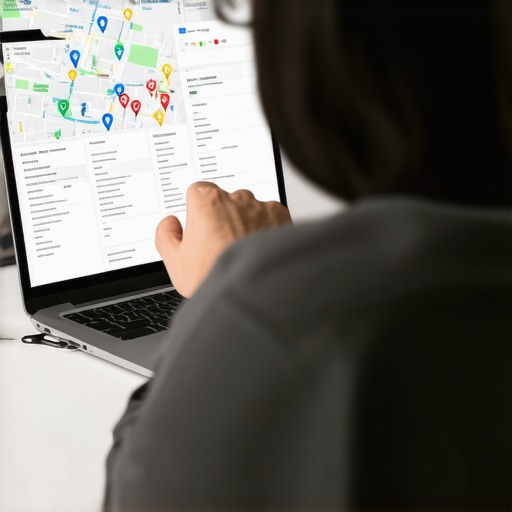
How do you know if your current SEO agency is actually doing the work or just “botting” your monthly reports? Most agencies will send you a report showing “Keyword Rankings” and “Total Backlinks.” These are vanity metrics. To truly understand your standing, you need to use a dedicated google business profile audit tool. You need to see your ranking not just from one point, but across a grid of your entire city. This is where you can identify “ranking dead zones” where your competitors are eating your lunch.
To get a real handle on your performance, you need professional-grade local seo tools. You shouldn’t be relying on the data your agency gives you; you should be verifying it yourself. A high-quality google maps rank tracker will show you your “Share of Voice” across your service area and help you identify if you are suffering from proximity suppression or if your “Interaction Score” is lagging behind the market leader. Use the following checklist to audit your current strategy:
- Geographic Link Audit: What percentage of your backlinks come from domains physically located within 50 miles of your business? If it’s less than 20%, you have a relevance problem.
- Interaction Velocity: Are you receiving at least 3-5 new, photo-rich reviews every month? If not, your “Interaction Score” is decaying.
- GPS Signal Stacking: Are you regularly “checking in” or dropping pins at job sites to provide Google with “Proof of Presence” data?
- Profile Health: Is your GBP updated weekly with new “Updates” (formerly Posts) that include local keywords and geo-tagged images?
If you find that your current strategy is lacking, it’s time to switch to a platform designed for the modern local landscape. I highly recommend using SEO Viper Tools to take control of your data. Don’t let an agency hide behind “Domain Authority” metrics that don’t pay the bills. Use a google business profile seo toolset that actually tracks what matters: your visibility in the 3-Pack and the phone calls that result from it.
Conclusion: The Future of Local Search
The era of gaming the system with cheap, generic backlinks is over. In 2026, Google is smarter, faster, and more focused on “Trust” than ever before. To rank higher on google maps and stay there, you must shift your focus from “Global Authority” to “Local Presence.” You need to build a Local Mesh, maximize your Interaction Score, and embrace the technical realities of GPS and 5G verification. Local seo for contractors and small businesses isn’t about who has the biggest budget for guest posts; it’s about who is the most “present” and “trusted” in their own backyard.
Stop wasting your hard-earned cash on SEO strategies that were designed for national blogs. Your business lives and dies by the 3-Pack. It’s time to treat your Google Business Profile with the technical respect it deserves. Use SEO Viper Tools to audit your local presence today, or reach out to me, Kevin Pauls, for a deep-dive consultation. Let’s stop the “backlink trap” and start building a google maps lead generation machine that actually works. The future of local search is here – make sure your business is part of it.