The Simple Move to Audit Your Competitor’s Local Search Traffic Source
There is nothing more frustrating for a business owner than doing everything “right” – getting the reviews, filling out the profile, posting updates – only to see a competitor consistently sit at the top of the Google 3-Pack. You look at their profile and think, “How are they doing it?” In my years as a strategist, I have found that most people are looking at the surface level when they should be looking at the plumbing. The secret to overtaking them isn’t just about working harder; it’s about working with better data. Today, I’m going to share the “Simple Move” to audit your competitor’s local search traffic source: the strategic combination of UTM parameter analysis and hidden category discovery.
Most businesses rely on standard analytics, but they fail to distinguish between generic “Organic Search” and actual “GBP Traffic” in GA4. This lack of granularity is where your competitors are likely gaining an edge. By understanding exactly where their traffic originates and which specific categories they are leveraging behind the scenes, you can reverse-engineer their success. This isn’t just google business profile seo; it is competitive intelligence that allows you to stop guessing and start winning.
Why You’re Losing the Map Pack War (And How Data Fixes It)
If you feel like you are losing the battle for the local map pack, it is likely because you are focused on the wrong metrics. Many business owners believe that more reviews automatically equate to a higher ranking. While reviews are a significant ranking factor, they are far from the only one. In the current landscape, Google prioritizes two critical, yet often overlooked, factors: the “Interaction Score” and “Proximity.”
The Interaction Score is a measure of how users engage with a listing. Does a user click the website link? Do they call the business? Do they request directions? If a competitor has a high interaction score, Google views them as the most relevant answer to a user’s query, even if they have fewer reviews than you. This is a concept I dive deep into in my article on Why Your Competitor Ranks Higher with Half the Reviews. Ranking isn’t just about static data; it’s about the flow of traffic. If you don’t know where your competitor’s traffic is coming from, you can’t compete with their interaction score.
Proximity remains a kingmaker in local search, but it is no longer an absolute barrier. Through proper google business profile seo, businesses can expand their “radius of relevance.” However, you cannot expand your reach if you are blind to the data. Data fixes the Map Pack war by showing you exactly which keywords are driving clicks and which geographic areas are underserved. When we audit a competitor, we aren’t just looking at their rank; we are looking at their digital footprint to see how they are signaling “relevance” to Google’s algorithm.
The “Simple Move” Step 1: Uncovering Hidden Competitor Categories
One of the most effective ways to jumpstart your local rankings is to identify the secondary categories your competitors are using. Google allows one primary category and up to nine secondary categories. While the primary category is visible to everyone, the secondary ones are often “hidden” from the casual observer. These secondary categories are often the reason a competitor shows up for a wide variety of search terms that you might be missing out on.
To uncover these hidden gems, you don’t need expensive software; you just need a browser and a little bit of technical curiosity. Here is the “Right-Click” method I use daily:
- Open Google Maps and search for your competitor’s business.
- Once their profile is open, right-click on the white space next to their primary category (e.g., “Plumber”).
- Select “View Page Source” from the menu.
- Press Ctrl+F (or Cmd+F on Mac) and search for the string of their primary category.
- Look closely at the code surrounding that primary category. You will see a list of other categories grouped together in the JSON-LD or HTML strings. These are the secondary categories they have selected.
By identifying these, you can see if they are targeting niche services that you’ve overlooked. For instance, a law firm might have “Personal Injury Lawyer” as their primary category, but their hidden categories might include “Trial Attorney,” “Legal Services,” or “Medical Lawyer.” If you only have one category selected, you are bringing a knife to a gunfight. This is one of those Google My Business Optimization Secrets Every Local SEO Consultant Should Know that can yield immediate results in your visibility.
The “Simple Move” Step 2: The UTM Parameter Hack
Traffic is the lifeblood of SEO, but not all traffic is created equal. To truly audit a competitor, you need to see if they are tracking their own success. This is where the UTM parameter hack comes in. A UTM code is a snippet of text added to the end of a URL that allows tools like Google Analytics 4 (GA4) to track exactly where a visitor came from.
When you look at a competitor’s Google Business Profile, hover your mouse over their “Website” button. Look at the URL that appears in the bottom corner of your browser. If you see a string that looks like ?utm_source=google&utm_medium=organic&utm_campaign=gbp_listing, you know two things immediately: first, they are working with a professional or are highly sophisticated in their marketing; and second, they are measuring the specific ROI of their Map Pack listing.
Why does this matter for your audit? Because it tells you which landing pages they value most. Often, a competitor won’t link to their homepage; they will link to a specific “location page” or “service page” optimized for local conversions. By analyzing their UTM structure, you can see how they categorize their traffic. If they are using local seo tools to monitor these parameters, they are likely adjusting their strategy based on which keywords drive the most “Book Now” clicks. You should be doing the same. Tagging your own links allows you to stop looking at “Organic” as a giant bucket and start seeing the specific value of your local profile.
Geo-Grid Auditing: Visualizing the Traffic Source
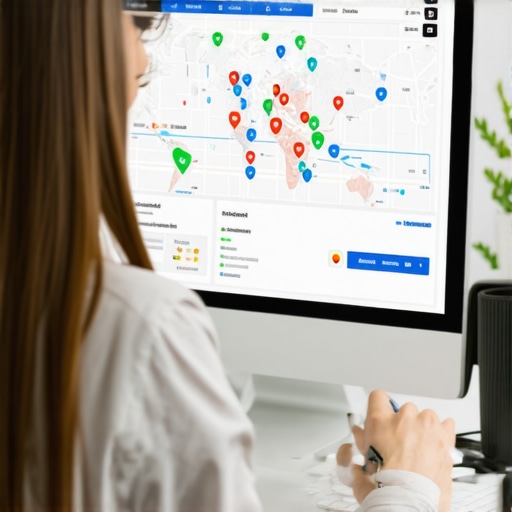
Local SEO is not a single point on a map; it is a grid. Just because you rank #1 when standing in your office doesn’t mean you rank #1 three blocks away. This is why geo-grid auditing is essential for a comprehensive competitor analysis. A geo-grid scan provides a visual heatmap of exactly where a competitor’s “territory” ends and where yours begins.
Using a google maps rank tracker, you can see a 5×5 or 7×7 grid of rankings over a specific geographic area. When I audit a client’s competitor, I look for “weak spots” in their grid. Perhaps they dominate the north side of the city but drop off significantly in the south. This tells me that their local signals (citations, proximity, and location-based content) are concentrated in one area.
This visualization is vital for correcting proximity issues. If you find that your rankings drop off abruptly, it might be time to implement some Is Your Shop Too Far? 2026 Google 3 Pack Proximity Fixes. By visualizing the traffic source geographically, you can shift your content strategy to mention specific neighborhoods or landmarks where your competitor is weak, effectively “stealing” their potential traffic before it even reaches them.
2026 Local SEO: Beyond the Basic Audit
As we move toward 2026, the landscape of local search is shifting. We are entering the era of the “Trust Update” and “AI-Filtered Map Pack Listings.” Google’s algorithm is becoming increasingly skeptical of “optimized” profiles that lack real-world substance. Today, the algorithm looks for “Proof of Presence” – signals that your business isn’t just a digital ghost but a physical reality with live interactions.
AI search agents are now filtering results before they even reach the user. If your profile doesn’t have a high “Live Interaction Score,” these agents might skip your business entirely. This is why a simple audit of categories and keywords is no longer enough. You must audit the trust signals of your competitors. Are they posting real photos of their team? Do their reviews mention specific employees or locations? These are the nuances that AI models use to verify a business’s legitimacy.
I’ve discussed this shift extensively in my recent guides on 5 Proven Map Pack SEO Fixes for the 2026 Trust Update [New] and Why AI Search Agents Skip Your Business in the 2026 3-Pack. To stay ahead, your audit must include an assessment of how “human” your competitor’s profile feels compared to yours. In 2026, the most “human” and verified profile often beats the most “optimized” one.
Actionable Checklist for Your Competitor Audit
To help you implement the “Simple Move” immediately, I have put together this actionable checklist. Follow these steps to gain a complete picture of your competitor’s local strategy:
- Check Primary and Secondary Categories: Use the “View Page Source” method to find every category your competitor is using.
- Analyze Review Velocity and Recency: It’s not just the total number of reviews; it’s how many they get per month. Use local seo software to track their growth rate.
- Inspect GBP Website Links: Look for UTM parameters to understand their tracking sophistication and landing page strategy.
- Run a Geo-Grid Scan: Use a ranking tool to see their geographic strengths and weaknesses.
- Audit Landing Page Relevance: Does their linked page mention the city and neighborhood multiple times? Is it mobile-responsive?
- Evaluate Interaction Signals: Check if they have “Google Messages” enabled or if they are frequently answering Q&As.
Conclusion & CTA
Local SEO is no longer a “set it and forget it” task. The “Simple Move” of auditing your competitor’s traffic sources – from hidden categories to UTM-tracked landing pages – is the difference between being a background player and the local leader. By digging into the technical data that your competitors hope you never see, you can build a strategy that is rooted in reality, not guesswork.
Stop letting your competitors dictate the market. It is time to take control of your data and your rankings. Ready to dominate? Use a professional google business profile audit tool like SEO Viper Tools to audit your profile today or contact me for a custom strategy tailored to your specific market. Let’s get you to the top of the 3-Pack.
Comments are closed.